


Views: 0 Author: Site Editor Publish Time: 2026-10-04 Origin: Site


Modern society relies heavily on robust energy infrastructure. These vital networks connect remote generation facilities to distant urban load centers. However, building long-distance high-voltage lines presents compounding challenges. Engineers must overcome extreme weather, immense mechanical loads, and limited right-of-way corridors. They also face strict safety regulations regarding phase-clearance tolerances. Designing structures to navigate these hurdles requires absolute precision.
Steel has become the undeniable industry standard for these networks. It provides the only viable balance of structural scalability and lifecycle cost-efficiency. Project developers trust it to deliver predictable mechanical performance. A well-engineered structure can maintain its integrity over a 50-plus year operational lifespan. We will explore exactly why these robust frameworks dominate modern grids. You will learn how material science, engineering compliance, and strategic planning converge to create reliable energy corridors.
Structural Integrity: Steel allows for the height and geometric configurations required to safely carry high-voltage (HV) and extra-high-voltage (EHV) lines.
Optimized Span Lengths: High tensile strength reduces the total number of structures needed per mile, lowering overall foundation and land acquisition costs.
Material Flexibility: Solutions range from traditional lattice structures for rugged terrain to tubular steel poles for space-constrained environments.
Lifecycle ROI: Galvanized steel mitigates degradation risks, offering a lower total cost of ownership compared to wood or concrete in long-distance applications.
Moving electricity across hundreds of miles requires highly specialized engineering. Long-distance grids operate at high voltages to minimize power loss. This fundamental physical reality dictates how we build support structures. We must engineer them to handle extreme electrical and physical stress.
High voltage requires significant air-gap insulation. Electricity naturally seeks the path of least resistance to the ground. When you transmit power at 345kV or 500kV, the air around the conductor acts as the primary insulator. If the wire drops too close to the earth, the current can arc. This arcing causes catastrophic grid faults and severe safety hazards.
A Power Tower provides the necessary height to maintain this critical clearance. Engineers calculate the exact distance needed between different phases of the electrical current. They also calculate the required distance to the ground. Steel allows manufacturers to build these tall, rigid structures without compromising stability.
A transmission structure must withstand immense physical forces. We classify these forces into three distinct categories. Engineers calculate these loads rigorously to ensure structural survival.
Vertical Loads: This includes the static weight of the conductors and heavy glass or polymer insulators. In winter environments, radial ice accumulation adds massive vertical weight. Steel handles this static compression flawlessly.
Transverse Loads: Wind creates significant lateral pressure. It pushes against the broad side of the tower. It also pushes against the miles of wire suspended between structures. Line angles also create transverse tension where the route changes direction.
Longitudinal Loads: Wires usually pull evenly in both directions. However, if a conductor breaks, the tension becomes unbalanced. The structure must absorb this sudden shock without snapping.
Alternative materials fail to meet long-distance demands. Wood poles suffer from height restrictions and rapid biological decay. They rarely support ultra-high voltages safely. Concrete is incredibly heavy and brittle. It requires massive transport logistics and struggles under extreme bending forces. Neither material offers the geometric flexibility or sheer tensile strength of steel.
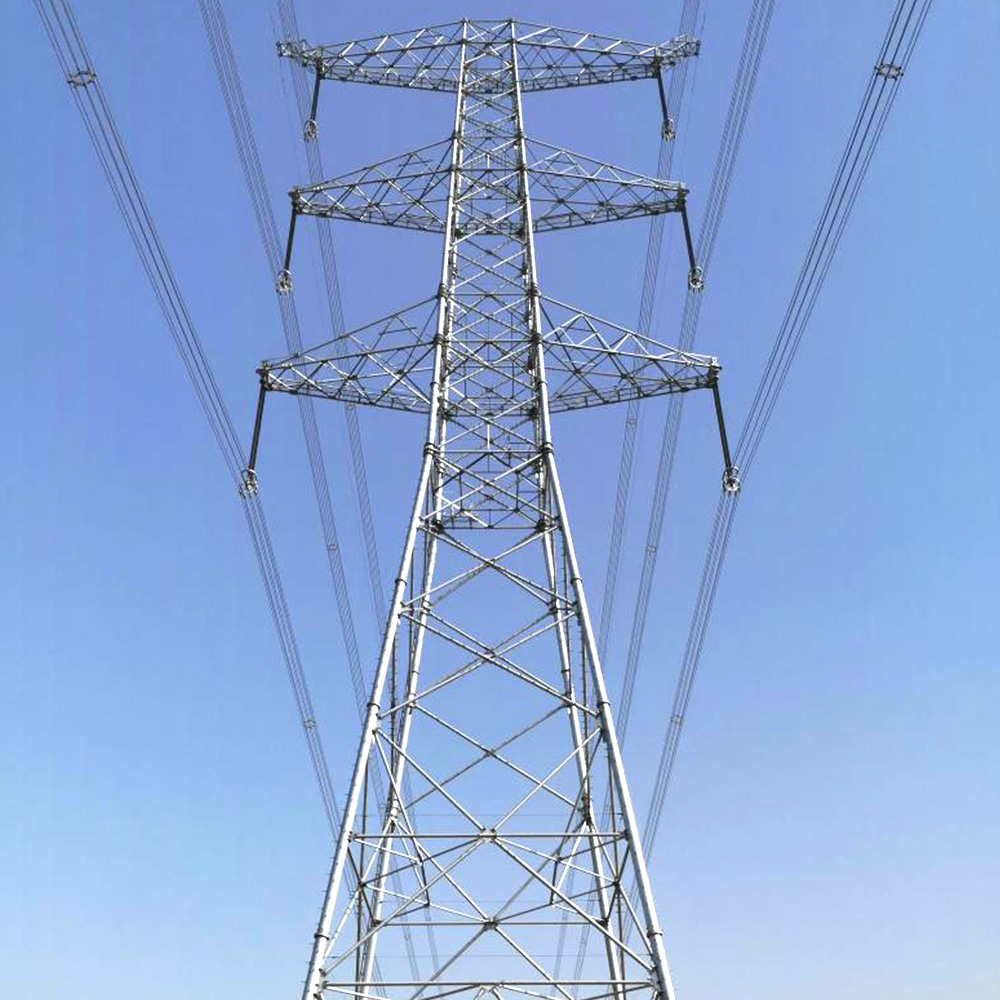
Grid developers do not use a one-size-fits-all approach. The terrain, budget, and local regulations dictate the physical shape of the support structure. Manufacturers primarily produce two distinct structural formats.
Lattice structures consist of interconnected steel angles. They form a wide, triangulated framework. They dominate rural and ultra-long-span projects.
Best for: Extra-High-Voltage (EHV) lines, remote mountainous terrain, and long river crossings.
Pros: They offer an incredible weight-to-strength ratio. Their open geometry allows wind to pass through easily. You can ship them in small bundles and assemble them entirely on-site.
Cons: They require a massive land footprint. On-site assembly demands hundreds of bolts and extensive manual labor.
Monopoles use large, hollow steel tubes. They feature a sleek, modern profile. Many suburban grids rely on these refined structures.
Best for: Urban corridors, narrow right-of-ways, and areas prioritizing aesthetic integration.
Pros: They occupy a very small ground footprint. Crews can install them rapidly using slip-joints or flanged connections.
Cons: Factories must ship them in massive, heavy sections. They carry higher initial manufacturing costs and offer limited capacity for ultra-long spans.
Project developers weigh multiple variables before selecting a format. They balance land acquisition expenses against manufacturing and labor costs. The chart below illustrates this decision-making process.
Structural Selection Matrix
Criteria | Lattice Steel Tower | Tubular Steel Pole |
|---|---|---|
Footprint & Right-of-Way | Requires wide, expensive corridors | Fits in narrow, restricted spaces |
Transport Logistics | Easy to ship in small components | Requires heavy-haul trucking routes |
Installation Speed | Slow (complex on-site bolting) | Fast (crane-assisted stacking) |
Span Capability | Excellent for ultra-long distances | Moderate, best for standard spacing |
Grid infrastructure represents a generational investment. Planners focus intensely on long-term operating expenses (OPEX). Every dollar saved on maintenance improves the economic viability of the grid. Steel delivers unparalleled longevity when treated correctly.
Steel rusts if left exposed. Industry leaders prevent this using Hot-Dip Galvanization (HDG). Workers submerge the steel in molten zinc. This creates a metallurgical bond. The zinc layer sacrifices itself to protect the underlying steel. A High-Strength Hot-Dip Galvanized Transmission Line Steel Tower can survive harsh weather for up to 80 years. Some projects use weathering steel. This alloy develops a stable rust-like patina. The patina acts as a protective barrier, eliminating the need for future painting.
We must look beyond initial capital expenditures. Steel offers exceptional tensile strength. This strength allows engineers to stretch conductors further between supports. Longer spans mean you need fewer structures per mile. Fewer structures directly translate to fewer expensive concrete foundations. You also reduce the number of glass insulators you must purchase. Over decades, this minimizes routine inspection points, drastically cutting operating expenses.
Standardized steel fabrication protects the grid during severe weather. When extreme winds or ice overload a line, one structure might fail. Steel frameworks absorb energy dynamically. Engineers design them to contain the damage locally. This prevents a catastrophic cascading failure. The "domino effect" ruins grids. Precise steel engineering stops it in its tracks.
Sourcing reliable infrastructure requires rigorous vetting. You cannot compromise on material quality or engineering accuracy. B2B buyers must evaluate suppliers using strict international standards.
Quality begins at the steel mill. Buyers must demand certified Mill Test Reports (MTRs). These documents verify the exact chemical composition of the steel. They confirm the yield strength. Excess carbon makes steel brittle and hard to weld. MTRs guarantee you receive the precise alloy your engineers specified. Read more about finding an accountable supplier by reviewing their About Us credentials to ensure they maintain strict supply chain transparency.
A reliable Transmission Steel Tower must adhere to structural codes. In North America, engineers use ASCE 10 for lattice frameworks. They apply ASCE 48 for tubular poles. International projects often rely on IEC standards. These codes dictate safety factors, wind load calculations, and connection designs. Ensure your fabricator employs engineers intimately familiar with these regulatory frameworks.
Top-tier manufacturers run rigorous quality control programs. Common mistakes occur when buyers ignore factory inspection data. Always look for these specific testing protocols:
Pre-assembly fit-up: The factory must assemble a prototype horizontally. This ensures all bolt holes align perfectly before mass production begins.
Galvanization checks: Inspectors must measure zinc thickness using magnetic gauges. They also test adhesion to prevent flaking.
Non-Destructive Testing (NDT): Technicians must inspect tubular pole welds using ultrasonic or magnetic particle tests. This detects hidden internal cracks.
Designing a great structure solves only half the problem. You must successfully install it in the field. Remote deployment involves significant logistical and geotechnical hurdles.
Transporting infrastructure to remote mountains requires strategic planning. Access roads often cannot support heavy trucks. Lattice components solve this problem perfectly. Crews can bundle the light steel angles. They load them onto smaller off-road vehicles. Sometimes, they use heavy-lift helicopters to fly bundles directly to mountain peaks. Tubular poles present a different challenge. Because they arrive in massive sections, they require wide turn radiuses and stabilized heavy-haul roads.
Soil conditions dictate your foundation strategy. Bedrock requires different techniques than swampy soil. A massive structure sinking into soft earth causes immediate grid failure. In firm soil, lattice structures often use grillage foundations. Crews bury steel frames directly in the earth. Tubular poles typically require deep drilled concrete piers. These massive concrete cylinders resist the extreme overturning moments generated by the tall pole.
Field assembly requires specialized labor. You need trained linemen and ironworkers. Lattice structures demand thousands of manual bolt connections. Workers must torque each nut precisely. Tubular poles assemble faster but require massive cranes. Scheduling heavy-lift cranes in remote areas often delays projects. Planners must align labor availability with equipment logistics.
Specifying a steel transmission structure remains a vital risk-management decision. Grid operators face immense pressure to deliver reliable power under extreme environmental constraints. Steel solves the core problems of mechanical loading, electrical clearance, and environmental degradation.
You ensure grid stability by balancing terrain limits with material capabilities. Moving forward, always engage structural engineers and steel fabricators during the initial routing phase. Early collaboration aligns your right-of-way constraints with realistic manufacturing tolerances. Prioritize material traceability and insist on strict galvanization standards to secure a resilient energy network for decades to come.
A: Engineers design their geometry specifically to manage mechanical forces. Wide bases resist the overturning moments caused by high winds. The extended horizontal arms maintain strict phase separation. This prevents high-voltage wires from swinging too close together and causing electrical arcs.
A: A high-quality galvanized structure typically lasts 50 to 80 years. The exact lifespan depends heavily on the local environment. Coastal areas with high salt spray or highly industrialized zones can accelerate corrosion, requiring more frequent inspection and maintenance.
A: Yes, engineers design them to meet specific regional wind-load standards. While no structure is entirely "storm-proof," modern grids utilize failure containment principles. If extreme winds overwhelm a line, specific components are engineered to fail safely, preventing a cascading collapse of the entire network.
A: Suspension towers support the wires in a straight line, carrying mostly vertical weight. Tension towers handle line angles or the end of a line. They are built much heavier to withstand massive horizontal pulling forces from the conductors.


