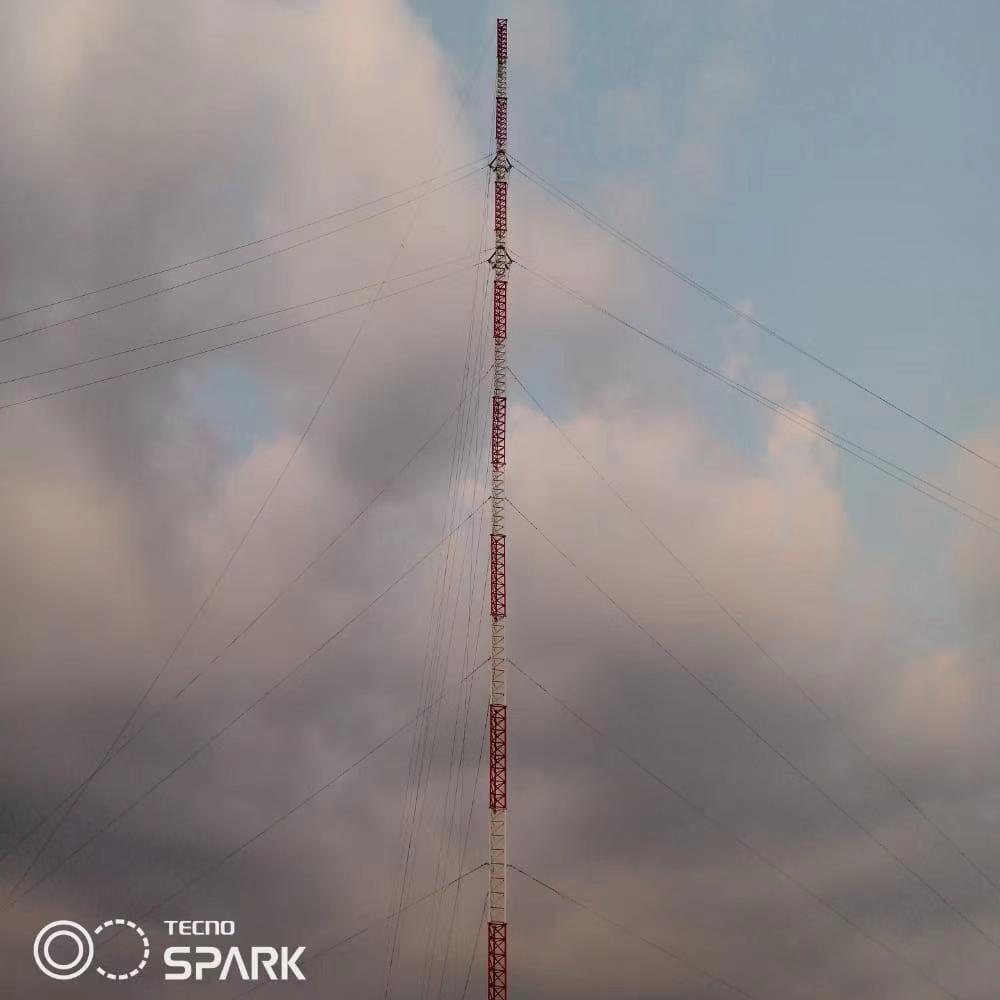
HDG Guyed Mast Antenna Tower for Telecom Solutions
HDG Guyed Mast Antenna Tower for Telecom Solutions is a tall, slender structure that is stabilized by multiple tensioned steel cables, called guy wires, which are anchored to the ground some distance away.
Guyed tower is a highly efficient structure that trades a large land area for exceptional height and low cost. They are typically the least expensive type of tower to build for a given height.
Type
Guyed mast tower
Height
Customized
Wind speed
Customized
Certificate
ISO9001
Surface treatment
Hot dip galvanized
Materials
Q235B(equivalent to S235JR/A36) & Q355B(equivalent to S355JR/GR50) & Q420B (equivalent to GR60)
Galvanized standard
ISO1461/ASTM A123
Design code
TIA/EIA-222G/H
Production capacity
6000tons/month
Nuts & Bolts
4.8, 6.8, 8.8
Lifetime
30 years
Guyed towers serve as essential infrastructure in the telecommunications and broadcasting sectors. Their primary function is to elevate antennas and other equipment to heights necessary for optimal signal transmission and reception. Key applications include:
Cellular Networks: Guyed towers support antennas for mobile communication signals, forming the backbone of cellular infrastructure and enabling widespread coverage for voice and data services.
Radio Broadcasting: These towers carry antennas for both AM and FM radio stations, facilitating the transmission of radio signals across extensive geographical areas.
Television Broadcasting: Guyed towers provide structural support for television broadcast antennas, ensuring reliable signal distribution to viewers over broad regions.
Dedicated Communication Systems: They support two-way radio communications for public safety services (police, fire, emergency), aviation communications, etc., ensuring critical communications infrastructure remains operational.
Lightweight Design
The structural efficiency of guyed towers stems from the fact that the guy wires assume the majority of mechanical loads. Since the mast itself does not need to resist bending moments or substantial lateral forces through its own cross-section, it can be designed with minimal material. Typically constructed using galvanized steel arranged in a lattice or tubular configuration, the mast serves mainly to elevate antennas and other equipment to operational heights. This design approach significantly reduces the amount of steel required compared to a self-supporting tower, yielding advantages in material cost, transportation, and assembly.
Reliance on Guy Wires
The guy wire system constitutes the defining characteristic of this tower type. Multiple sets of cables are attached at various elevations along the mast, with each set comprising three or four wires spaced at equal angles around the tower circumference. These cables are anchored to concrete foundations, screw anchors, or rock anchors embedded in the ground, forming a symmetrical support pattern. The tension in each wire is carefully calibrated to maintain mast stability, with upper guy sets providing greater leverage against overturning moments. This configuration enables the tower to withstand high wind speeds and dynamic loads through a network of balanced tensile forces.
Large Footprint Requirement
A fundamental spatial characteristic of guyed towers is their extensive ground area requirement. Although the mast base itself occupies a small footprint, the anchor points for the guy wires must be positioned at a distance approximately two-thirds of the tower's height from the center point. This creates a circular safety perimeter—often termed a "fall zone" or "clear zone"—that must remain unobstructed. This zone serves both safety and functional purposes: it protects against potential ice shedding from cables or rare structural incidents, while also ensuring the integrity of the anchor system remains uncompromised by external interference.
1. What is a guyed tower? A guyed tower is a tall, slender structure that is stabilized by high-tension steel cables, known as guy wires or guy lines. These cables are anchored to the ground some distance from the tower's base, providing the primary support against wind and other lateral forces.
2. What are the main advantages of using a guyed tower? The primary advantages are:
Cost-Effectiveness: They are the most economical way to achieve significant height.
Material Efficiency: They use significantly less steel and have a smaller foundation than a self-supporting tower of the same height.
Height: They can be built much taller than other tower types for a fraction of the cost.
3. Can guyed towers withstand extreme weather? Yes, when properly engineered. Guyed towers are designed to withstand specific wind speeds, ice loads, and seismic conditions based on their location and purpose.
4. Are there different types of guyed towers?
Yes, main types include:
Lattice masts: Triangular or square cross-sections made of steel angles
Tubular masts: Cylindrical steel poles
Hybrid designs: Combining lattice and tubular sections Each type has different strength, cost, and maintenance characteristics.