


Views: 0 Author: Site Editor Publish Time: 2026-10-08 Origin: Site


The global race for 5G dominance relies heavily on rapid network densification. Carriers deploy new C-band and mmWave frequencies to deliver ultra-fast speeds. These high-frequency bands travel shorter distances and struggle to penetrate buildings. Therefore, carriers must position cellular sites directly adjacent to end-users to guarantee high-speed, ultra-low-latency connectivity. Unfortunately, urban centers, suburban zones, and Multi-Dwelling Unit (MDU) environments provide severely limited usable ground space.
Network planners face a frustrating structural trade-off every day. Traditional lattice structures require massive land parcels. These large plots simply do not exist in modern city centers. Meanwhile, rooftop deployments constantly hit strict structural load maximums. Property owners also impose rigid leasing restrictions. The Monopole Tower emerges as the ultimate architectural bridge. It perfectly balances tight spatial constraints, the heavy payload demands of Massive MIMO equipment, and strict municipal zoning laws.
In this guide, you will discover the advanced engineering mechanics behind these streamlined structures. We will explore complex foundation prerequisites, aesthetic zoning advantages, and smart vendor evaluation strategies. You will understand precisely how these modern telecom structures accelerate your critical network rollout timelines.
Minimal Footprint: Monopole towers require up to 75% less ground space than equivalent lattice structures, enabling deployment in urban right-of-ways and constrained lots.
Zoning Compliance: Sleek, customizable aesthetics (including camouflage options) significantly accelerate municipal permitting and community acceptance.
Deployment Velocity: Pre-fabricated slip-joint or flanged designs allow for rapid single-day vertical erection once foundations are cured.
Economics and Scalability: High-grade galvanized steel construction ensures long-term corrosion resistance while supporting multi-tenant equipment stacking.
Urban macro-cell deployments face harsh physical boundaries today. City planners rarely allocate empty lots for new telecom infrastructure. Real estate commands a massive premium everywhere. Network engineers must squeeze vital equipment into narrow alleys, highway right-of-ways, or tiny utility strips. Network densification requires placing base stations much closer together. This proximity requirement drastically reduces your available site options.
Let us compare base footprint requirements across common infrastructure types. Traditional lattice structures demand extensive land. They rely on broad, triangular, or square baselines for vertical stability. Finding this much open space in a suburban neighborhood proves nearly impossible. Guyed masts require even more lateral space. Their extensive anchor radii often stretch for hundreds of feet in multiple directions. A single centralized foundation makes the monopole structure vastly superior. It fits effortlessly into extremely constrained environments.
Land acquisition carries immense hidden costs. Property owners charge high lease rates based strictly on leased square footage. Securing a massive 50-by-50 foot compound hurts your operating expenses severely. You must minimize the physical footprint to keep site leasing costs manageable. By using vertically oriented single-pole structures, carriers dramatically slash long-term land OPEX. They maximize network coverage while minimizing their physical ground presence.
Infrastructure Footprint Comparison
Structure Type | Base Requirement | Urban Suitability | Land Leasing Impact |
|---|---|---|---|
Lattice | Broad baseline (3-4 legs) | Low | Very High |
Guyed Mast | Extensive anchor radii | Very Low | Maximum |
Monopole | Consolidated single foundation | High | Minimal |
Modern 5G antennas weigh significantly more than older 4G models. Advanced Massive MIMO equipment features heavy integrated Remote Radio Units (RRUs). A single sector deployment can easily exceed hundreds of pounds. This extra equipment creates a massive wind load profile at the absolute peak of the structure. Engineers must carefully calculate how these slender poles handle increased top-heavy stress during severe weather. A continuous taper design provides the elegant solution. It lowers the center of gravity while maintaining excellent aerodynamic efficiency against crosswinds.
Deflection and sway represent critical engineering limits. All tall steel poles bend under high wind speeds. This sway tolerance poses no problem for standard 4G and 5G cellular panels. Cellular antennas possess a very wide radio frequency beamwidth. However, you must perform careful calculations if you co-locate microwave backhaul dishes. Microwave links rely on highly precise point-to-point line-of-sight alignment. Excessive sway causes immediate link degradation or total signal loss.
Material quality directly dictates structural longevity. Manufacturers rely on high-yield strength steel plates to prevent permanent deformation under load. Harsh urban environments expose these poles to constant vehicle pollution, acid rain, and moisture. Hot-dip galvanization serves as the ultimate defense mechanism against environmental decay. The zinc coating bonds metallurgically to the steel during the dipping process. It prevents rust and structural fatigue over decades of continuous field use.
Verify the exact steel yield strength before finalizing purchase orders.
Confirm the galvanization thickness meets strict ASTM A123 industry standards.
Recalculate your twist and sway limits before adding sensitive microwave dishes.
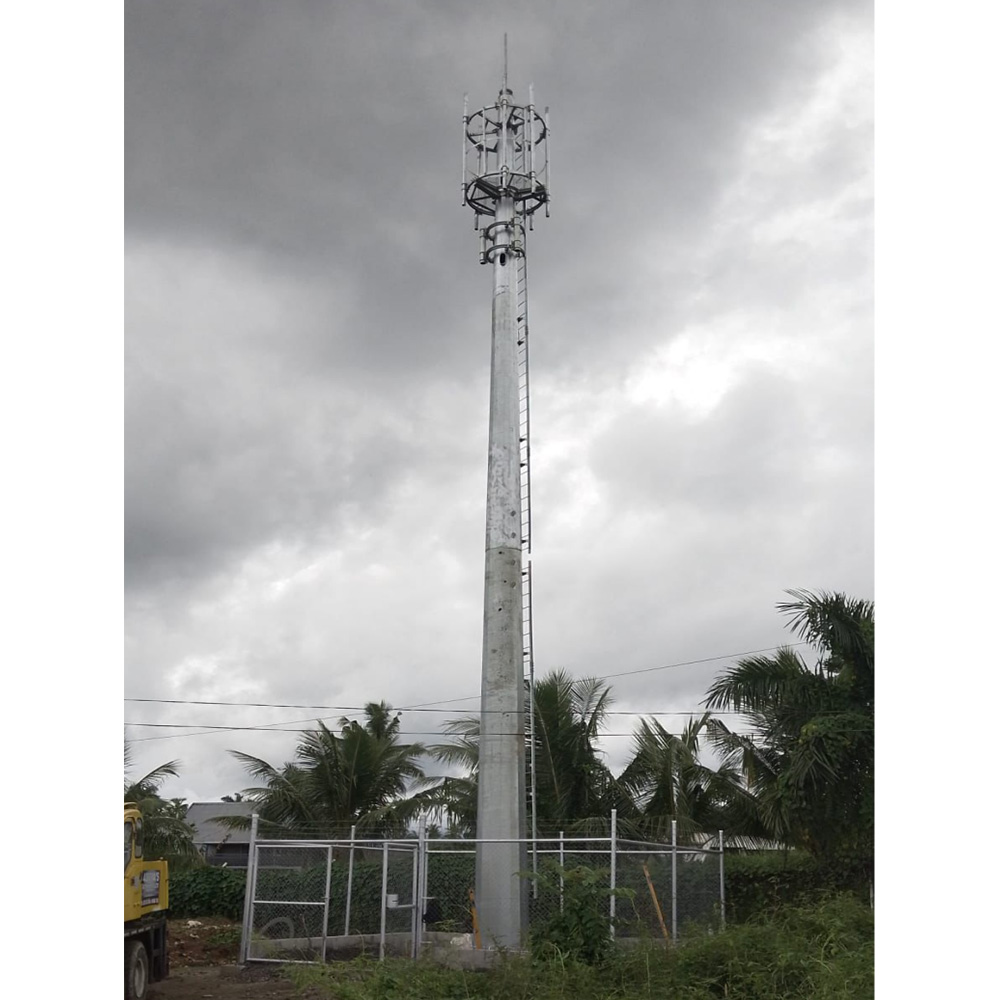
Visual impact studies frequently delay traditional telecom infrastructure projects. Local municipalities actively dislike the industrial look of lattice designs. Community groups fiercely protest large steel frameworks. Residents fear these large structures will lower their surrounding property values. This intense permitting bottleneck severely damages deployment timelines. Navigating hostile variance hearings often wastes months of valuable network rollout time.
Aesthetic integration effortlessly bypasses this intense zoning friction. You can deploy a sleek telecommunication tower blending seamlessly into the local landscape. Vendors offer specialized smart poles specifically designed for street-level urban deployment. These compact structures mimic standard streetlights perfectly. Concealment options like monopines camouflage the steel inside incredibly realistic artificial tree branches. Flagpole variants completely hide bulky antennas within visually opaque cylindrical shrouds.
Regulatory compliance remains strictly enforced despite these impressive visual upgrades. Your site must meet local height restrictions effortlessly. Furthermore, structures must strictly adhere to complex TIA-222 structural codes. These national standards govern strict wind and ice loading parameters. Choosing pre-engineered, visually appealing designs significantly accelerates municipal permitting. Planning commissions approve these unobtrusive solutions quickly. They recognize the community benefits without forcing you into endless variance hearings.
Building any vertical infrastructure requires precise geotechnical preparation. Underground soil conditions absolutely dictate your base engineering approach. Soft urban soils or sandy deposits often require deep drilled pier foundations. Heavy machinery must auger deep into the earth to find stable resistance. Conversely, rocky substrates might allow for broader, shallower pad-and-pier designs.
Mobilizing heavy machinery introduces severe logistical risks. Erecting a tall pole requires heavy-duty lifting cranes. Navigating these massive cranes through tight urban alleys presents a massive operational challenge. You might also struggle to access restricted MDU properties through narrow access gates. Planners must carefully map out crane access routes before scheduling deployment. Proper traffic staging prevents costly street blockages and keeps property managers happy.
Modular assembly offers massive installation advantages. Manufacturers produce these heavy poles in convenient slip-fitted or flanged sections. This clever modularity minimizes your on-site construction time dramatically. Crews can stack and bolt the individual sections very rapidly. Once the concrete foundation fully cures, contractors often complete the vertical erection in a single day.
Follow this standardized site preparation sequence for optimal efficiency:
Conduct a deep geotechnical soil boring test to determine earth composition.
Secure municipal street closure permits for heavy crane access.
Pour the customized concrete foundation and wait for complete curing.
Assemble the bottom flanged section of the monopole base station securely.
Stack the remaining slip-joint sections vertically using the crane.
Selecting the right manufacturer guarantees a highly successful network rollout. You need absolute engineering transparency from your chosen fabrication partner. Ensure they provide site-specific structural analyses before metal production begins. They must share accurate wind-load ratings and clear foundation design reactions. Never accept generic load charts for a customized site build.
Customization capabilities matter deeply for your long-term network scalability. Look for high modularity in the pole design. You want the distinct ability to add physical extensions later. Ensure the supplier offers highly specific multi-carrier mounting hardware. This hardware compatibility makes future colocation upgrades much easier to execute. Ask about their platform mounts and T-arm arrays during the initial consultation.
Evaluate the supply chain and quality assurance processes rigorously. Investigate vendor lead times to prevent frustrating deployment delays. Demand transparent raw material sourcing data. Traceable steel grades prove the manufacturer never cuts corners on material strength. Check for verifiable anti-corrosion warranties covering the galvanization. When visiting a vendor's website, read their about us page carefully. Assess their manufacturing heritage and history of successful telecom deployments. Reliable vendors will always showcase their welding certifications and quality control protocols proudly.
Network planners face immense pressure to expand 4G and 5G coverage rapidly. Severe real estate scarcity presents the biggest hurdle to this ambitious goal. The single-pole structure remains the most viable path to scaling modern networks in crowded spaces. It provides the necessary structural height and payload capacity. It achieves this without demanding massive, expensive land parcels.
Upfront foundation construction costs might seem high initially. However, you will achieve massive financial savings in land leasing over time. Expedited zoning approvals and single-day deployment speeds yield a vastly superior return on investment. You eliminate months of wasted time sitting in local permitting offices.
Take decisive action on your network densification strategy today:
Initiate comprehensive site audits for your planned coverage zones immediately.
Request preliminary wind-load modeling from certified steel fabricators.
Prioritize modular, aesthetically pleasing designs to keep your deployment schedule perfectly on track.
A: Standard heights typically range from 30 meters to 60 meters (100 to 200 feet). Pushing beyond 60 meters requires a significantly wider base diameter to handle increased wind loads. At that point, the expanded foundation footprint negates the primary benefit of space-constrained deployments.
A: Yes, they frequently support multiple tenants. Platform mounts and T-arm arrays allow carriers to stack equipment vertically. However, engineers must specifically design the initial structural load capacity to handle the cumulative wind resistance of multiple Massive MIMO panels.
A: A single-pole structure easily fits within a tiny 10-by-10 foot leased compound. Conversely, a standard lattice structure requires massive triangular or square baselines. These broad baselines demand significantly larger land parcels, driving up leasing costs in urban environments.
A: These structures require very minimal maintenance. Crews should perform periodic torque checks on all flanged connection bolts. Additionally, technicians must conduct visual inspections of the hot-dip galvanization integrity every three to five years to ensure rust has not penetrated the protective zinc coating.


