


Views: 0 Author: Site Editor Publish Time: 2026-09-01 Origin: Site


Network densification and rapid 5G rollouts demand placing telecommunications equipment closer to residential neighborhoods and commercial centers. Unfortunately, this necessary expansion triggers severe zoning friction and intense community "NIMBY" (Not In My Back Yard) backlash. Standard steel monopoles and traditional lattice structures face exceedingly high rejection rates in aesthetically regulated municipalities. These ongoing disputes heavily delay deployment timelines and dramatically inflate site acquisition costs. Deploying a purpose-built Camouflage tower successfully bridges the gap between strict network coverage requirements and local aesthetic mandates. By disguising critical infrastructure, telecom operators easily bypass visual pollution concerns. This comprehensive guide evaluates eight proven concealment strategies for modern networks. We assess their regional viability, detail strict structural realities, and outline their precise impact on deployment speeds. You will learn how to choose the best disguise for your exact municipal environment.
Properly specified camouflage towers significantly reduce zoning board friction and accelerate site approval timelines.
Concealment effectiveness relies entirely on local context—a fake pine tree in a desert biome draws more negative attention than a standard monopole.
Evaluating stealth options requires balancing visual aesthetics with engineering realities, including wind loading, RF transparency, and long-term material degradation.
While initial CapEx is higher for stealth structures, the ROI is realized through faster permitting and unlocking otherwise restricted high-value coverage areas.
Visual impact studies often reveal deep public resistance to visible telecom hardware. Stealth designs successfully neutralize community protests by removing the harsh industrial appearance of cellular arrays. They preserve community property value perceptions while satisfying critical network coverage gaps. When citizens cannot see the raw steel and cabling, municipalities experience far fewer formal complaints. Planners must respect community aesthetics to secure site approvals.
Strict municipal aesthetic codes heavily restrict new telecom infrastructure. Navigating historical district regulations becomes manageable when you present pre-engineered, context-aware designs. Planning boards generally approve concealed structures faster because they align directly with local beautification mandates. A proactive visual concealment strategy effectively disarms the most common arguments used to block new building permits.
Modern operational realities dictate a massive shift in infrastructure placement. Millimeter-wave (mmWave) and C-band deployments require lower, densely packed transmission nodes. Concealment is now non-negotiable across tight urban and suburban corridors. Building a customized Camouflage tower ensures carriers can hit critical elevation requirements without triggering civic alarm. We must integrate these hidden nodes seamlessly to maintain necessary data speeds.
Monopines replicate the look of large evergreen trees. They remain the most recognizable form of stealth telecom architecture.
Best for: Suburban and rural environments in the Northeast, Pacific Northwest, and heavily wooded areas.
Key detail: Requires high-density branch counts and realistic bark texturing to avoid the dreaded "toilet brush" effect. Planners must account for significant wind load additions.
Best Practice: Always match the pine species to the surrounding native canopy. A towering 120-foot fake pine looks ridiculous inside a forest of 40-foot oak trees. Engineers must calculate the Effective Projected Area (EPA) rigorously. Dense artificial branches capture enormous amounts of wind.
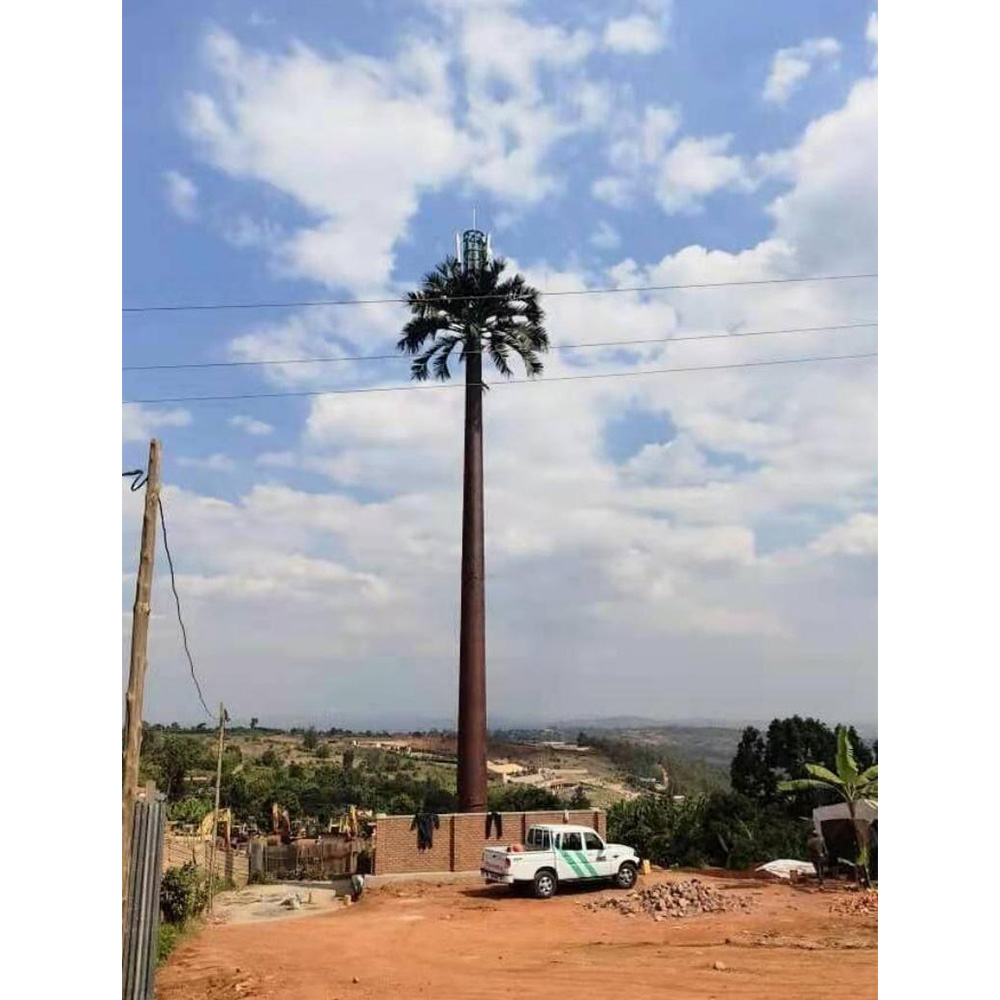
Desert and tropical regions demand completely different botanical disguises. Monopalms and faux saguaro cacti fill this regional necessity perfectly.
Best for: The Southwest (e.g., Phoenix valleys), Southern California, and tropical climates.
Key detail: Frond material must be highly UV-resistant to prevent premature fading and structural brittleness.
Common Mistake: Skimping on UV-stabilized plastics leads to rapid sun bleaching. A bright blue or yellowing plastic palm frond destroys the visual illusion entirely. You must replace deteriorated fronds promptly to maintain compliance.
Industrial concealment leverages existing municipal architecture. Simulated smokestacks hide multi-carrier equipment seamlessly inside structural cylinders.
Best for: Industrial parks, retrofitted factories, and historical urban rooftops.
Key detail: Utilizes RF-transparent fiberglass (FRP) matched directly to existing brickwork or distressed concrete aesthetics.
Experience Tip: When designing a faux chimney, incorporate fake soot and weather staining. Pristine masonry stands out glaringly against a 100-year-old factory roof. Engineers routinely texture the fiberglass panels to mimic rough mortar joints.
Religious institutions frequently partner with telecom operators. They offer prime vertical real estate in the center of dense residential zones.
Best for: Community centers, historical towns, and restricted residential zones.
Key detail: Often structured as a mutually beneficial lease agreement with local institutions. They are highly effective at hiding multi-carrier arrays.
Best Practice: Ensure the internal steeple framework allows enough physical access for maintenance crews. You must utilize specialized RF-transparent siding that mimics traditional wooden shingles or slate tiles.
Clock towers act as functional civic landmarks. They pull double duty by telling time and broadcasting cellular signals.
Best for: Retail centers, commercial business parks, and busy town squares.
Key detail: Allows for ample internal space to house bulky equipment while serving as a functional community landmark.
Experience Tip: The expanded footprint of a clock tower permits housing base station cabinets internally. This eliminates the need for ugly exterior ground compounds. Local governments often favor these designs because they enhance public spaces.
Water towers represent standard fixtures in rural landscapes. Building a fake water tower offers massive internal capacity for high-density antenna configurations.
Best for: Flat rural areas, municipal land, and expansive agricultural zones.
Key detail: Can disguise massive antenna arrays behind RF-friendly composite panels disguised as weathered steel or painted wood.
Common Mistake: Failing to match the typical leg structure of genuine local water towers ruins the effect. The structural design must reflect regional water tank engineering styles exactly.
Flagpoles provide the slimmest profile available. They enclose antennas inside a slick, narrow cylinder.
Best for: Tight urban footprints, corporate campuses, and areas strictly enforcing height restrictions.
Key detail: Uses a sleek, radome-enclosed cylinder. Limited equipment space means strict payload management for structural engineers.
Best Practice: Heat dissipation inside narrow radomes is notoriously poor. You must ensure active or passive ventilation systems adequately cool the enclosed radios.
Rooftop setups dominate city deployments. However, landlords increasingly demand that carriers hide their hardware from street-level views.
Best for: Dense urban environments and commercial rooftops.
Key detail: Replaces standard building materials with customized, painted-to-match RF-transparent screens that blend into existing architecture.
Experience Tip: Survey the exact paint codes and stucco textures of the host building. An RF screen colored slightly off-white on a pure white building attracts instant attention. The camouflage must be absolute.
The absolute primary rule of camouflage is blending in perfectly. Assessing local flora, historical architecture, and skyline silhouettes before proposing a design is mandatory. A stealth site fails if citizens notice it immediately. We highly recommend conducting thorough site walks. Document the average tree heights, predominant architectural styles, and surrounding sightlines. This contextual data drives the entire engineering process.
Factoring in the weight and wind-drag of faux branches or architectural facades is critical. You are adding massive amounts of synthetic material to a steel pole. Ensuring the structure can handle future carrier additions without compromising the disguise requires advanced structural analysis. Engineers strictly adhere to ANSI/TIA-222 standards when calculating ice and wind loads. Overloading a stealth structure invites catastrophic foundation failures during severe weather events.
The telecom equipment must function efficiently despite being enclosed. Ensuring that the materials used (fiberglass, specialized epoxies, synthetic foliage) do not cause severe signal attenuation is paramount. This is especially true for higher frequency 5G bands, which struggle to penetrate dense obstacles. Fabrication partners must provide certified laboratory test results proving their materials offer minimal decibel loss. Selecting the wrong plastics can cripple network performance.
Stealth Type | Best Environment | Visual Impact Profile | RF Transparency Challenge |
|---|---|---|---|
Monopine | Forested, Suburban | High (requires dense branch count) | Low (signal passes through gaps) |
Faux Chimney | Industrial, Historic Urban | Low (blends with existing brick) | Moderate (FRP thickness matters) |
Concealed Flagpole | Corporate Campus, Urban | Very Low (slimline profile) | Moderate (radome material density) |
Clock Tower | Retail Centers, Town Squares | Positive (civic landmark) | High (requires large RF paneling) |
Stealth towers cost more upfront to fabricate than standard raw steel monopoles. Planners must budget carefully for custom engineering and premium composite materials. The specialized labor required to assemble faux branches or architectural facades drives up initial capital expenditure. However, you often recoup these expenses rapidly. Fast-tracked municipal approvals get your network on-air months earlier, generating revenue much sooner.
Synthetic leaves, faux bark, and custom paint ultimately fade over time. Prolonged UV exposure and extreme weather heavily degrade outdoor plastics. Budgeting for periodic "re-leafing" or exterior facade repairs is strictly essential. Ignoring this maintenance turns a stealth site into an eyesore, triggering new community complaints. We recommend scheduling thorough visual inspections every three to five years to assess material degradation.
Not all steel fabricators can build stealth structures successfully. The necessity of partnering with vendors who possess in-house RF testing and aesthetic design teams cannot be overstated. Standard welders lack the expertise to formulate RF-neutral fiberglass resins. You must procure a highly engineered Camouflage tower from established industry specialists. They understand exactly how to balance disguise weight against tower foundation strength.
Commission high-quality photo simulations to present to stakeholders. Show accurate before-and-after renderings from multiple community vantage points. This transparency builds vital trust with zoning boards. It proves you respect their visual landscape before asking for permits.
Bring conceptual stealth designs to municipal planners early. Gauge acceptable aesthetic parameters before investing heavily in deep engineering. A brief preliminary meeting saves thousands of dollars in redesign fees. Ask planners directly which stealth form factors they favor.
Demand RF signal loss data and UV-degradation warranties from your stealth fabrication partner. Do this strictly before signing any procurement contracts. You must ensure the chosen synthetic materials can survive your specific regional climate without destroying 5G signal propagation.
Camouflaged cell towers represent a strategic necessity in modern network deployments. Standard bare monopoles simply no longer pass strict municipal zoning reviews in densely populated areas. By embracing creative concealment strategies like monopines, faux chimneys, and clock towers, operators neutralize community resistance effectively. You actively accelerate deployment timelines while expanding your high-speed coverage footprint. Remember, the most successful camouflage tower is always the one the community never notices. You achieve this invisibility through rigorous contextual planning, utilizing uncompromising material quality, and applying expert structural engineering. Assess your next targeted deployment zone carefully, consult local planners early, and choose a stealth structure that honors the surrounding landscape.
A: A stealth structure typically carries a 30% to 100% premium over bare standard monopoles. This higher upfront capital expenditure covers custom steel fabrication, UV-resistant synthetic foliage, RF-transparent radomes, and specialized engineering. Prices scale directly based on specific disguise complexity, branch density, and regional wind-loading requirements.
A: They can introduce minor attenuation. However, modern artificial foliage uses specialized RF-transparent plastics and epoxies to minimize signal disruption. Engineers test these synthetic materials specifically for high-frequency 5G transmission. Proper installation ensures faux branches obscure the visual profile without heavily obstructing the antenna’s primary broadcast sector.
A: High-quality stealth materials generally last between 10 and 15 years before requiring heavy physical maintenance. Continuous UV exposure eventually causes synthetic leaves to fade and become brittle. Operators must plan for periodic "re-leafing" or facade repainting cycles to maintain civic aesthetic standards.
A: Yes, retrofitting is occasionally possible, but it faces strict engineering limitations. Adding synthetic branches or composite facades significantly increases overall weight and wind-drag. Engineers must perform rigorous structural analyses to confirm the older steel foundation safely supports the massive new environmental loads.


